The 5 points of sail, explained simply
Short answer: the points of sail describe the angle between your boat and the wind. There are five: close-hauled, close reach, beam reach, broad reach and run. Each one needs your sails set differently. Learn them and you’ll always know where to put the sails, which is half of sailing.
Here are all five points of sail, explained simply, with how to trim your sails on each.
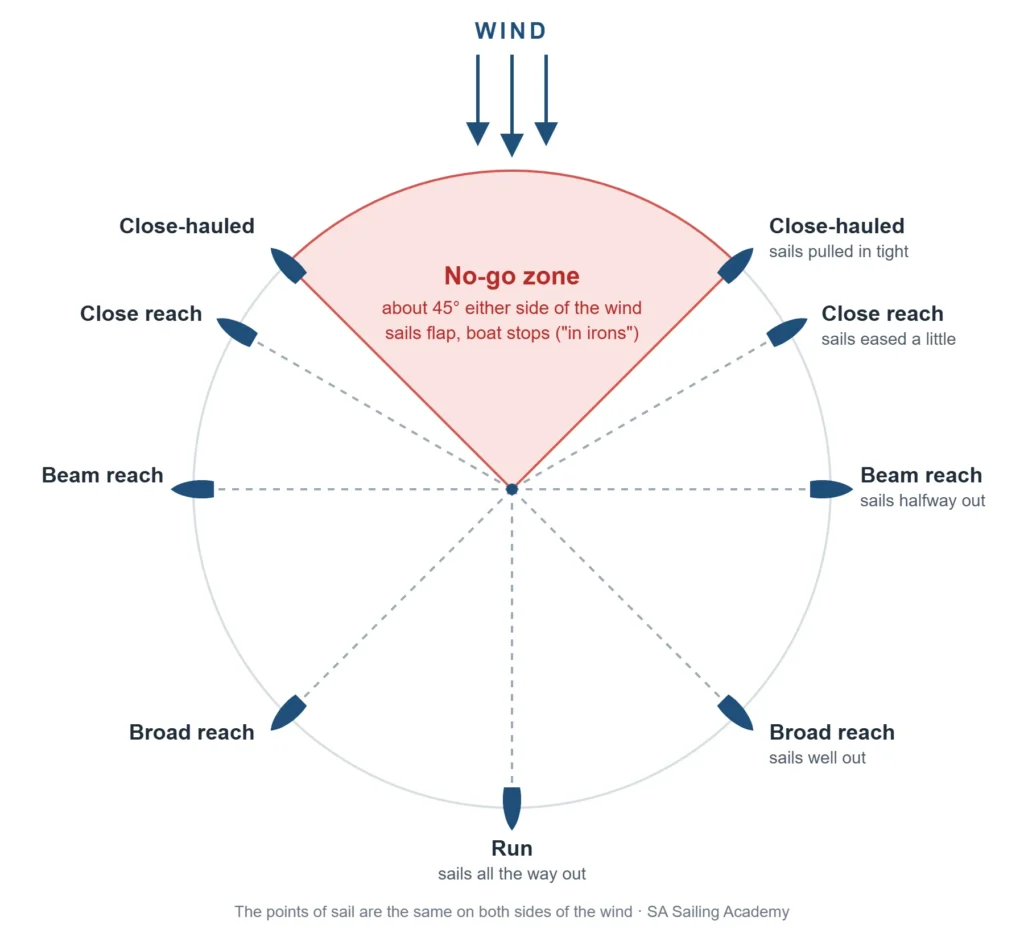
The points of sail at a glance
| Point of sail | Angle to the wind (approx.) | Sails | What it feels like |
|---|---|---|---|
| No-go zone | 0–45° | Flapping, no drive | The boat slows and stops |
| Close-hauled | About 45° | Pulled in tight | Heeling, wet, sailing as close to the wind as you can |
| Close reach | About 60° | Eased a little | Powerful and fast, a bit lumpy |
| Beam reach | 90° | About halfway out | Fast and easy, the wind on your side |
| Broad reach | About 135° | Well out | Fast, smooth, often the most fun |
| Run | 180° | All the way out | Calm and quiet, but watch for an accidental gybe |
The no-go zone
No sailing boat can sail straight into the wind. Point within roughly 45° of it and the sails flap, the boat slows, and eventually you stop. Sailors call this being “in irons”.
To get out, push the boom out towards the wind (or hold the jib out to the side). The bow will swing away from the wind. When the sails fill again, pull them in and steer onto your new course.
To reach a spot upwind, you zigzag instead: sail close-hauled one way, tack, then sail close-hauled the other way. We cover this in Perfecting Your Tacks & Gybes.
Close-hauled
Close-hauled is as close to the wind as the boat will sail, about 45° off it. Pull the sails in tight and steer by the telltales on the jib or the front of the mainsail. If the inside telltales lift, bear away a little. If the outside ones lift, head up.
The boat heels more here than anywhere else, so in a dinghy you’ll be hiking out to keep it flat. Flat is fast.
Close reach
Turn a little further away from the wind, to about 60°, and ease the sails out a touch. You’re on a close reach. It’s powerful, and in a breeze it can be a wet ride.

Beam reach
On a beam reach the wind comes straight across the side of the boat, at 90°. Let the sails out about halfway. For most dinghies this is the fastest point of sail and the easiest to learn on, which is why we start beginners here.
Broad reach
Keep turning away until the wind comes over your back quarter, at about 135°, and let the sails well out. Broad reaching is smooth and fast. Hobies and boats with gennakers really come alive here.
Run
On a run the wind is directly behind you. Let the sails all the way out. In a dinghy you can set the jib on the opposite side to the main, called “goose-winging” or “wing-on-wing”.
A run feels gentle because you’re moving with the wind. The danger is an accidental gybe: if the wind gets behind the mainsail, the boom swings across hard. Keep the wind just off one side of the stern, and keep your head down.

How to tell where the wind is coming from
- Feel it. Turn your face until the wind blows evenly on both cheeks. That’s where it’s coming from.
- Look up. A burgee or wind indicator at the top of the mast points away from the wind.
- Look at the water. Ripples and dark patches show where gusts are coming from.
- Watch the telltales. The ribbons on your sails show how the wind is flowing across them.
Good to know
Which point of sail is the fastest?
For most dinghies, a beam reach. Lighter, high-performance boats, like Hobies and boats flying a gennaker, are often fastest on a broad reach.
Can a sailing boat sail directly into the wind?
No. Every sailing boat has a no-go zone of roughly 45° either side of the wind. To go upwind, you zigzag by tacking.
Is running downwind the easiest point of sail?
It feels the calmest, but it isn’t the easiest. The boat rolls more and an accidental gybe can catch you out. Beginners usually find a beam reach easier.
What’s the difference between tacking and gybing?
Tacking turns the bow through the wind. Gybing turns the stern through the wind. Both change which side the sails are on.
Learn the points of sail on the water
The points of sail are the first thing we teach on our dinghy and Hobie courses at Theewaterskloof, and on Keelboat Level 1 in Gordon’s Bay. By the end of your first day you’ll be sailing every one of them.
Wondering how long it takes to get there? Here is a stage-by-stage sailing timeline.
Not sure where to start? Read Dinghy, Hobie or keelboat: which should you learn first? or book a course.