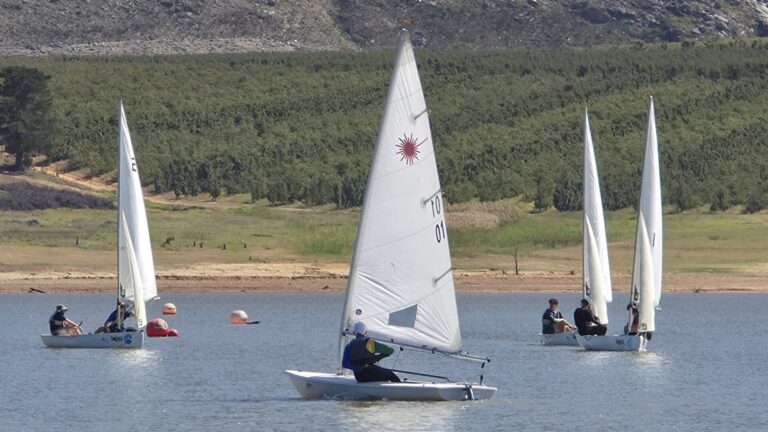
Tacking in sailing: how to tack a dinghy, step by step
Short answer: tacking is how a sailing boat turns through the wind, moving the wind from one side of the boat to the other. Because no boat can sail straight into the wind, tacking is how you get upwind. You zigzag, tacking from one close-hauled course to the other.
It’s the first manoeuvre we teach on every course, and the one most beginners worry about. Here’s how to tack a dinghy step by step, the calls to use, and the mistakes that leave you stuck head to wind.

What is tacking in sailing?
Every sailing boat has a no-go zone of roughly 45° either side of the wind. Point into it and the sails flap and the boat stops. (If you’re not sure what close-hauled means, start with the 5 points of sail, explained simply.)
To reach a spot upwind, you sail close-hauled on one side of the no-go zone, then turn the bow through the wind and sail close-hauled on the other side. That turn is a tack. From one close-hauled course to the other, the boat turns through about 90°.
Sailors also use “tack” for which side the wind is coming from. Wind over the right (starboard) side means you’re on starboard tack. Wind over the left (port) side means you’re on port tack.
Before you tack
- Look around. Check the water you’ll be sailing into after the tack is clear of other boats, moorings and the shore.
- Get up to speed. Sail close-hauled with the sails pulled in and the telltales flowing. Speed carries you through the turn.
- Know your new course. Pick a landmark roughly 90° from where you’re heading now. That’s about where you’ll end up.
How to tack a dinghy, step by step
These steps are for a two-person dinghy with a tiller, like the Topaz we use at Theewater. Sailing alone, you do both jobs.
- Helm calls “Ready about!” The crew checks the jib sheet is ready to release and answers “Ready!”.
- Helm calls “Lee-oh!” and pushes the tiller. Push it smoothly towards the sail, away from you. Don’t shove it hard over; a steady push turns the boat without stopping it.
- Release the jib. As the bow passes through the wind and the jib starts to flap, the crew lets go of the old jib sheet.
- Duck and cross. Both sailors move across the boat, ducking under the boom as it swings over. Face forward as you cross, so you can see where you’re going.
- Swap hands. The helm changes the tiller extension and mainsheet into the opposite hands on the new side. This is the part that takes practice; we do it on land first.
- Straighten up and sheet in. Centre the tiller as the boat settles on its new close-hauled course. The crew pulls in the new jib sheet, and both of you sit out to keep the boat flat.

Common tacking mistakes (and how to fix them)
Getting stuck in irons
The boat stops head to wind and won’t turn either way. It’s usually caused by going into the tack too slowly, or from a reach without first heading up to close-hauled. To get out, push the boom out towards the wind (the crew can hold the jib out on the same side). The bow will swing away. When the sails fill, pull them in and get moving again.
Pushing the tiller too hard
A rudder pushed hard over acts like a brake. Push smoothly and keep the turn going, rather than slamming it across.
Crossing too early or too late
Move across as the boom comes over, not before and not after. Too early and you tip the boat on top of yourself; too late and the boat heels over and slows.
Letting go of the mainsheet
If the mainsheet slips out while you swap hands, the sail flaps and you lose all your drive. Hold onto it; swap the tiller first, then the sheet.
Turning too far
Over-steer past close-hauled and you end up on a reach, losing the ground you made upwind. Watch your landmark and the telltales, and stop the turn when the jib just fills.
Tacking a Hobie or a keelboat
Hobie catamarans are light and have two hulls, so they lose speed quickly in a tack and are more likely to stall head to wind. Build plenty of speed first, keep the turn smooth and steady, and keep steering right through. If the bow stalls, the crew can hold the jib out to the old side (“backing” it) to push it round. We cover this in learn to sail a Hobie.

Keelboats carry their speed much better, so tacking is more forgiving. The calls are the same, but the crew’s job changes: release the old jib sheet off its winch, then pull in and winch the new one as fast as possible as the boat comes round. Tacking a yacht in a crew is one of the core skills on Keelboat Level 1 in Gordon’s Bay.
Tacking vs gybing
Both manoeuvres move the sails to the other side of the boat. Tacking turns the bow through the wind and is how you go upwind. Gybing turns the stern through the wind and is how you change direction downwind. A tack is slower and gentler; in a gybe the boom swings across quickly, so it needs more control. Once you’re tacking confidently, the next step is perfecting your tacks and gybes for racing.
Good to know
What does tacking mean in sailing?
Tacking means turning the bow of the boat through the wind, so the wind moves from one side of the boat to the other and the sails swap sides. It’s how sailors zigzag upwind.
How does a sailing boat go against the wind?
It can’t sail straight into it. A boat can sail at about 45° to the wind, so to reach a point upwind you sail close-hauled one way, tack, then sail close-hauled the other way. This zigzag is called beating.
What do you say before you tack?
The helm calls “Ready about!” and waits for the crew to answer “Ready!”. Then the helm calls “Lee-oh!” (some sailors say “Tacking!” or “Helm’s a-lee”) and starts the turn.
Why does my boat get stuck when I tack?
Usually there wasn’t enough speed going into the turn, or the tiller was pushed too far and too hard, which acts as a brake. Build speed close-hauled first, then push the tiller smoothly. If you do get stuck in irons, push the boom out towards the wind and let the bow fall away.
What’s the difference between tacking and gybing?
Tacking turns the bow through the wind; gybing turns the stern through the wind. A tack is slower and gentler. In a gybe the boom swings across fast, so it needs more control.
Learn to tack on the water
Most of our students are tacking on their own by the end of their first day. Join a dinghy or Hobie course at Theewaterskloof, or Keelboat Level 1 in Gordon’s Bay, and we’ll take you through it step by step.
New to sailing? Read how to learn to sail: a beginner’s step-by-step guide, or book a course.