How to learn to sail: a beginner’s step-by-step guide
Short answer: Choose the type of boat that suits you, book a 2-day beginner course with a qualified instructor on sheltered water, wear the right kit, then keep sailing straight away through rentals, further levels or club racing. You don’t need your own boat, any experience or a yacht club membership to start.
We’ve been teaching people to sail since December 2011, and the path that works best is always the same. Here is my step-by-step guide, with links to the detailed guides for each stage.
Step 1: Decide what you want to sail
- A dinghy if you want to really feel how a boat sails, or to race one day.
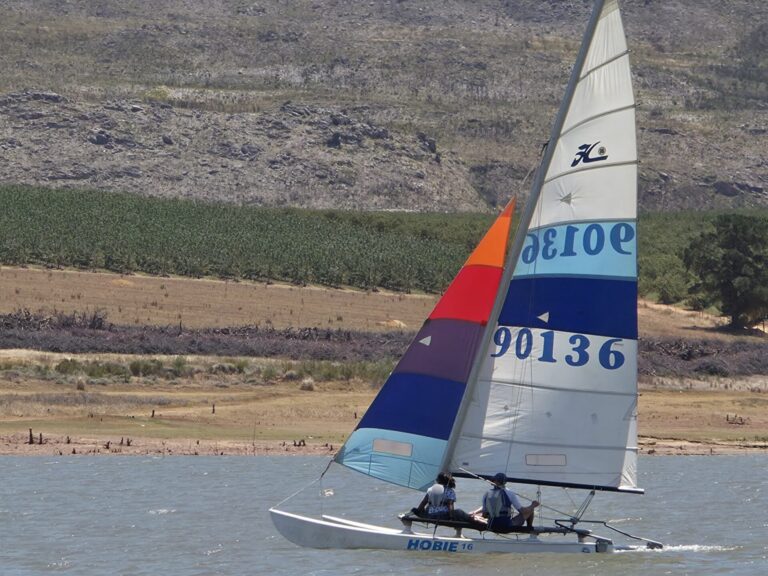
- A Hobie catamaran if you want a stable, forgiving boat with plenty of speed. Here is our beginner’s guide to the Hobie 16.
- A keelboat if your goal is to crew or skipper a yacht at sea. Read yachting qualifications in South Africa to see where it leads.
Still unsure? Compare all three in dinghy, Hobie or keelboat: which should you learn first? Many sailors start in a dinghy and move to keelboats later.
Step 2: Learn on sheltered water
Flat water with no tides or waves is the easiest place to start, because you can concentrate on the boat. In the Western Cape that means a dam such as Theewaterskloof. Keelboat skills are built at sea, in a protected bay like False Bay off Gordon’s Bay.
Step 3: Book a beginner course
A good beginner course runs over two days, with a qualified instructor and a safety boat on the water the whole time. You’ll learn to rig the boat, steer, sail in different directions, tack and gybe, and what to do if something goes wrong. Most people are sailing on their own by the end of the second day.
Look for accredited training that ends with a certificate. With us, a 2-day beginner course costs R1,895 per person; all course prices are on one page.
Step 4: Get the right kit
Dress for wind and getting wet, not for the weather on shore. Life jackets are provided. Here is our what to wear sailing checklist.
Step 5: Learn a little theory
You don’t need much before your first sail, but understanding the 5 points of sail makes everything on the water click faster. After that, learn the basic sail controls.
Step 6: Keep sailing
- Practise straight away. Two days in a row beat two days a month apart, and the same goes for the weeks after your course.
- Rent a boat. Boat rentals are the cheapest way to build hours once you can sail on your own.
- Work through the levels. On keelboats, Levels 1 to 4 lead to the Competent Crew qualification.
- Try racing. It’s the fastest way to improve. Here is why you should race a dinghy.
Who can learn to sail?
- Children: from about 9 on youth courses, and younger on family weekends with a parent. See what age kids can start sailing.
- Adults: at any age. It is never too late to start.
- Swimming: you need to be able to stay afloat. Everyone wears a life jacket.
- Fitness: everyday fitness is enough to learn. It matters more once you race; see fitness in sailing.
How long does it take?
You can sail a small boat on your own after a weekend. Becoming a confident, all-weather sailor takes a season or two. The full timeline is in how long does it take to learn to sail?
FAQ
What is the best boat to learn to sail on?
A small dinghy teaches you feel fastest, a Hobie 16 catamaran is the most stable and forgiving, and a keelboat suits people who want to sail yachts at sea. Read dinghy, Hobie or keelboat to choose.
Can I teach myself to sail?
You can, but a short course with an instructor and a safety boat gets you safe and independent much faster, and you avoid learning bad habits. See how long it takes to learn to sail.
How much does it cost to learn to sail?
With us, a 2-day beginner course is R1,895 per person. The cost of learning to sail in South Africa covers every option.
What age can you learn to sail?
Children can join our youth courses from about 9, and there is no minimum age on family weekends. Adults can start at any age. Read what age kids can start sailing.
Ready to start? Choose a course date, see sailing lessons near Cape Town, or WhatsApp me on 072 219 5951.